The New-Coach Bounce Is Real. It Just Doesn't Tell You How the Season Ends
Milan's first win under Luca Banchi looks like the classic jolt. Twelve recent EuroLeague coaching changes say the jolt is common and the forecast it seems to offer is mostly noise.
The Fifth Foul ·
Three games is enough time to judge a new coach, as long as you don't mind being wrong.
Milan is the latest test case. Olimpia relieved Peppe Poeta of his duties on November 6 with the team at 1-9 and eight straight losses deep. Luca Banchi was appointed two days later. His debut against Žalgiris ended 83-86, a ninth straight defeat. Five days later his team beat Crvena Zvezda 91-77, winning the second half 49-33 and forcing 18 turnovers. In his first statement back, Banchi said he was starting the job "with the enthusiasm and determination of someone who wants to prove to be worthy of such a prestigious job." By Tuesday night it looked like he meant it.
So is this the bounce? Probably, yes. I just wouldn't read the rest of Milan's season off it, and Banchi's own record is the best reason why.
The jolt is real
I went through 12 mid-season changes from 2021-22 to now, game by game, EuroLeague regular season only. In the last games before each change (the outgoing coach's final five, or fewer if he didn't last that long), those teams went 12-44. In each new permanent coach's first five, they went 30-27. That's a jump from about .21 to about .53, and eight of the 12 teams did better straight away.
Some of those jolts were dramatic. When Zvezda replaced Vladimir Jovanović with Duško Ivanović in November 2022, the team was 1-6. Ivanović won his first six. The margins tell you something too: 71-67 over ASVEL, 88-84 in Berlin, 69-68 over Maccabi. That is a team suddenly winning the close ones it had been losing.
Zvezda did it again in October 2025. Ioannis Sfairopoulos was gone after an 0-2 start, assistant Tomislav Tomović won his only game in charge 86-81 in Istanbul, and Saša Obradović won his first six. That made seven straight.
Fenerbahçe's version is the one every sporting director dreams about. The club parted with Dimitris Itoudis on December 13, 2023, at 6-7 after losing four of five, and named Šarūnas Jasikevičius the next day. Jasikevičius won his first three, beating Monaco, Žalgiris and ALBA, and went 4-1 in his first five.
Barcelona got two bumps for the price of one. After Joan Peñarroya was let go on November 9, 2025, at 5-4, interim coach Òscar Orellana won both his games. Xavi Pascual then went 4-1 in his first five.
It isn't automatic
The bounce is common, but it isn't guaranteed. Some teams changed coaches and simply kept falling.
When Željko Obradović left Partizan at the end of November 2025, the team was 4-9. Interim coach Mirko Očokoljić went 2-2, and one of those wins was 79-76 over Zvezda. Then Peñarroya arrived on December 23 and lost his first five, conceding 112, 86, 101, 88 and 104 points.
Efes fired Igor Kokoškov on November 27, 2025, at 5-8. Radovan Trifunović lost both games as interim, and Pablo Laso, appointed December 13, won his debut 87-64 in Kaunas before losing the next four.
The live version is in Vitoria. Baskonia moved on from Paolo Galbiati at 1-4 in October and brought back Velimir Perasović. Perasović is 0-7, and Baskonia sit last at 1-11.
Then there's the case that sits awkwardly in any "bounce" story: Zvezda in October 2023. Ivanović, the hero of 2022, was let go after a 1-3 start. Sfairopoulos lost his first game 86-88 at Partizan and went 2-3 in his first five, barely better than what he inherited. The same club, the same October panic, and a different result.
The bounce lies both ways
The bounce isn't fake. The trouble is that it's a weak forecast.
Take the five best starts in the sample: Ivanović 5-0, Obradović at Zvezda 5-0, and three 4-1s from Jasikevičius, Obradović at Monaco and Pascual. Those five seasons ended with one Final Four (Fenerbahçe, who lost both games there), one playoff exit in Game 5 (Monaco, 15-13 and seventh), two play-in exits (Zvezda and Barcelona, both 21-17), and one tenth place with no postseason at all (Zvezda in 2022-23, at 17-17).
A word on Monaco, because the record books are strange that season. Obradović took over on December 13, 2021, and one of his first five games as played was a loss to Zenit, one of the Russian clubs that were later expelled. The EuroLeague stripped every result against CSKA, Zenit and UNICS from the 2021-22 standings. Officially, he went 4-1 in his first five and 12-4 overall after inheriting a 3-9 team.
Now look at the other direction. Virtus Bologna were 2-11 on a five-game losing streak when their coach resigned in December 2024. Ivanović, again, took over and won his debut 82-81 in Vitoria, going 3-2 in his first five. That's a textbook bounce. Virtus finished 9-25, 17th.
And then there's the coach in Milan's dugout. In January 2025 Banchi replaced Tomislav Mijatović at Efes, with the team at 10-9 and having won three of its last five. He lost his first three games: 76-82 at home to ASVEL, 84-88 in Paris, 80-90 in Barcelona. If anyone had judged him after three games, it would have been ugly. His fourth game was a 110-66 win over Milan. Counting that one, Efes went 10-2 the rest of the way, finished his spell 10-5, made the playoffs and took Panathinaikos to a fifth game in Athens before losing it 75-67.
So the coach who had no bounce at Efes got further than almost everyone who did. And the team he had left in Bologna got its bounce, then finished 17th.
What the bounce actually measures
Here's my opinion on why this happens: the first five games measure the change of voice. The next 25 measure the roster.
Part of the bounce is simple arithmetic. Clubs fire coaches at the bottom of a slump, a combined 12-44 in this sample, so some recovery was coming whoever sat on the bench. Part of it is emotional and real. Players who had stopped listening start listening, rotations get reset, and the close games flip, which is exactly what Ivanović's early margins in 2022 looked like.
None of that changes who is on the floor. Fenerbahçe in 2023 and Efes in 2025 were good rosters playing badly, and a new coach let them play to their level. Virtus at 2-11 and Baskonia now were rosters with deeper problems, and no voice was going to fix them. Zvezda has done both in four years: the bounce worked in 2022 and 2025, didn't in 2023, and none of the three seasons reached the playoffs.
One honest caveat. These are 12 changes, many of them with five-game windows, which makes this a pattern to argue about, not a law. One injury or one buzzer-beater can turn a 2-3 into a 3-2. That's the point, though. A sample that small can't carry the weight people put on it.
What Milan's next week can tell us
Milan host Fenerbahçe on Thursday. Then comes the trip to ASVEL on November 24, and Eurohoops reports that assistant Marco Ramondino is expected to coach that game while Banchi joins Italy's national team. A part-time bounce is a new idea even by EuroLeague standards.
Whatever happens, the next two games will tell us about mood: whether the defence that produced 13 steals against Zvezda was a performance or a habit. They won't tell us where Milan finish. At 2-10, the honest question isn't whether Banchi brought a bounce. He did. The question is whether the roster is a Fenerbahçe or a Virtus.
Banchi himself proved that three games can lie. Milan should be the last club in Europe to believe them.
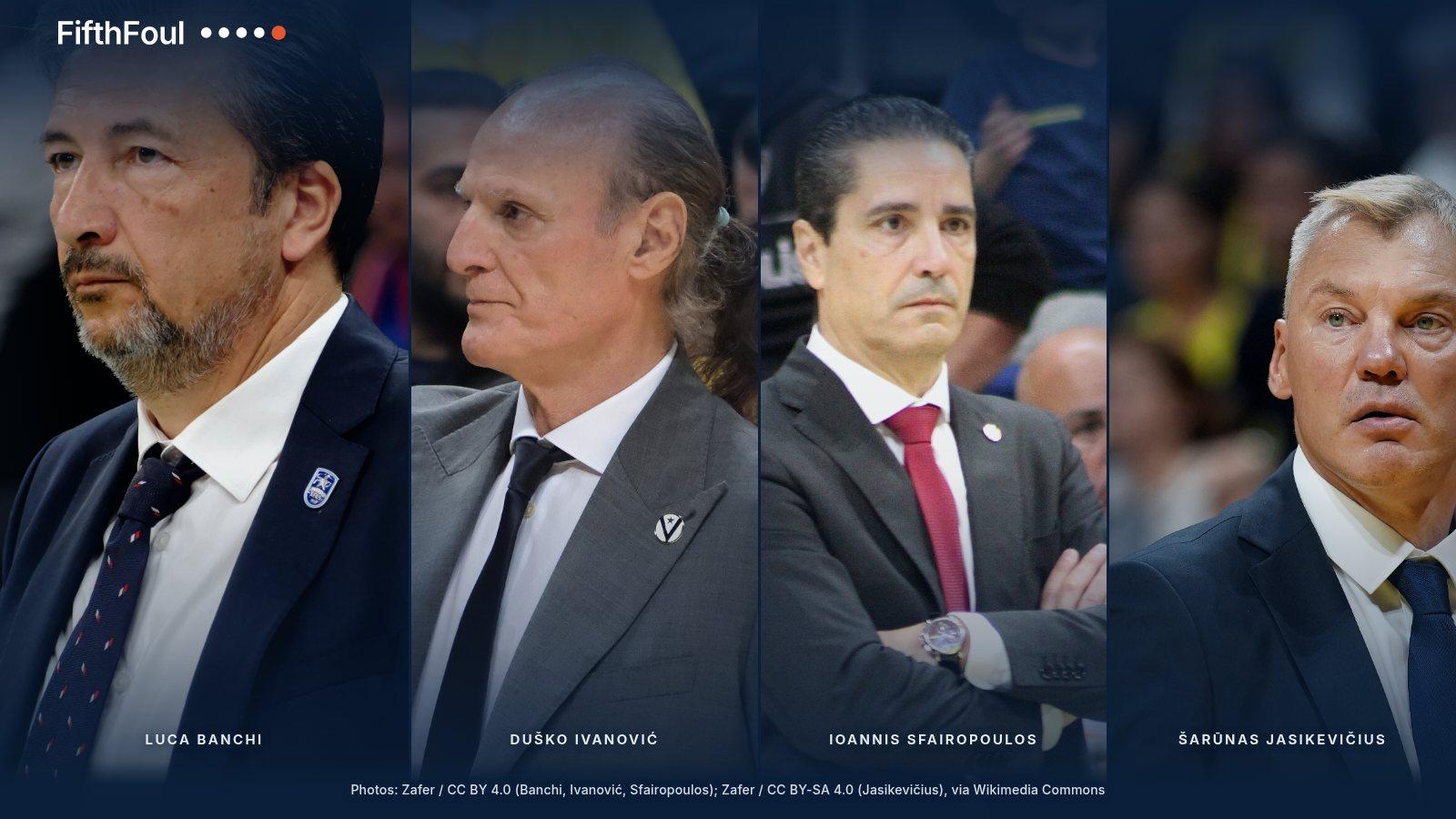
Hero photos: Zafer / CC BY 4.0 (Banchi, Ivanović, Sfairopoulos); Zafer / CC BY-SA 4.0 (Jasikevičius), via Wikimedia Commons. Cropped and colour-graded by FifthFoul.